Minimalism Op Art and Geometric Abstraction Have Which of the Following in Common?

Op art, short for optical art, is a style of visual art that uses optical illusions.[1]
Op fine art works are abstract, with many amend known pieces created in black and white. Typically, they give the viewer the impression of motility, hidden images, flashing and vibrating patterns, or of swelling or warping.
History [edit]

Francis Picabia, c. 1921–22, Optophone I, encre, aquarelle et mine de plomb sur papier, 72 × 60 cm. Reproduced in Galeries Dalmau, Picabia, exhibition catalogue, Barcelona, November eighteen – December 8, 1922.

The antecedents of op art, in terms of graphic and color furnishings, can be traced back to Neo-impressionism, Cubism, Futurism, Constructivism and Dada.[2] László Moholy-Nagy produced photographic op art and taught the subject in the Bauhaus. One of his lessons consisted of making his students produce holes in cards and then photographing them.[ citation needed ]
Time magazine coined the term op fine art in 1964, in response to Julian Stanczak'due south show Optical Paintings at the Martha Jackson Gallery, to mean a form of abstract art (specifically non-objective fine art) that uses optical illusions.[3] [4] Works now described equally "op art" had been produced for several years before Fourth dimension's 1964 commodity. For example, Victor Vasarely'south painting Zebras (1938) is made up entirely of curvilinear black and white stripes not independent past contour lines. Consequently, the stripes appear to both meld into and flare-up forth from the surrounding background. Also, the early on black and white "dazzle" panels that John McHale installed at the This Is Tomorrow exhibit in 1956 and his Pandora serial at the Institute of Contemporary Arts in 1962 demonstrate proto-op art tendencies. Martin Gardner featured op Fine art and its relation to mathematics in his July 1965 Mathematical Games column in Scientific American. In Italia, Franco Grignani, who originally trained as an architect, became a leading strength of graphic design where op art or kinetic art was fundamental. His Woolmark logo (launched in Uk in 1964) is probably the most famous of all his designs.[v]

Op fine art perhaps more than closely derives from the constructivist practices of the Bauhaus.[6] This German schoolhouse, founded by Walter Gropius, stressed the relationship of form and function within a framework of analysis and rationality. Students learned to focus on the overall design or entire composition to nowadays unified works. Op art also stems from trompe-50'œil and anamorphosis. Links with psychological inquiry have also been made, particularly with Gestalt theory and psychophysiology.[2] When the Bauhaus was forced to close in 1933, many of its instructors fled to the United States. In that location, the movement took root in Chicago and eventually at the Black Mountain College in Asheville, N Carolina, where Anni and Josef Albers eventually taught.[7]
Op artists thus managed to exploit diverse phenomena," writes Popper, "the after-epitome and consecutive move; line interference; the issue of dazzle; cryptic figures and reversible perspective; successive colour contrasts and chromatic vibration; and in three-dimensional works different viewpoints and the superimposition of elements in space.[ii]
In 1955, for the exhibition Mouvements at the Denise René gallery in Paris, Victor Vasarely and Pontus Hulten promoted in their "Yellow manifesto" some new kinetic expressions based on optical and luminous phenomenon every bit well as painting illusionism. The expression kinetic fine art in this modern form start appeared at the Museum für Gestaltung of Zürich in 1960, and found its major developments in the 1960s. In most European countries, information technology more often than not includes the form of optical art that mainly makes employ of optical illusions, like op art, as well as fine art based on movement represented past Yacov Agam, Carlos Cruz-Diez, Jesús Rafael Soto, Gregorio Vardanega or Nicolas Schöffer. From 1961 to 1968, the Groupe de Recherche d'Art Visuel (GRAV) founded by François Morellet, Julio Le Parc, Francisco Sobrino, Horacio Garcia Rossi, Yvaral, Joël Stein and Vera Molnár was a commonage group of opto-kinetic artists that—according to its 1963 manifesto—appealed to the direct participation of the public with an influence on its behavior, notably through the use of interactive labyrinths.
Some members of the group Nouvelle tendance (1961–1965) in Europe also were engaged in op art equally Almir Mavignier and Gerhard von Graevenitz, mainly with their serigraphics. They studied optical illusions. The term op irritated many of the artists labeled under it, specifically including Albers and Stanczak. They had discussed upon the nativity of the term a better label, namely perceptual art.[8] From 1964, Arnold Schmidt (Arnold Alfred Schmidt) had several solo exhibitions of his big, blackness and white shaped optical paintings exhibited at the Terrain Gallery in New York.[9]
The Responsive Heart [edit]
In 1965, betwixt February 23 and April 25, an exhibition called The Responsive Eye, created by William C. Seitz, was held at the Museum of Modern Art in New York Metropolis and toured to St. Louis, Seattle, Pasadena, and Baltimore.[10] [eleven] The works shown were wide-ranging, encompassing the minimalism of Frank Stella and Ellsworth Kelly, the smooth plasticity of Alexander Liberman, the collaborative efforts of the Anonima group, alongside the well-known Victor Vasarely, Richard Anuszkiewicz, Wen-Ying Tsai, Bridget Riley and Getulio Alviani. The exhibition focused on the perceptual aspects of art, which result both from the illusion of motion and the interaction of color relationships.
The exhibition was a success with the public (company omnipresence was over 180,000),[12] simply less and then with the critics.[thirteen] Critics dismissed op art as portraying nada more than trompe-l'œil, or tricks that fool the centre. Regardless, the public's acceptance increased, and op art images were used in a number of commercial contexts. One of Brian de Palma's early works was a documentary film on the exhibition.[14]
Method of operation [edit]
Black-and-white and the effigy-ground human relationship [edit]
Op art is a perceptual experience related to how vision functions. It is a dynamic visual fine art that stems from a discordant effigy-footing relationship that puts the ii planes—foreground and background—in a tense and contradictory juxtaposition. Artists create op art in two primary ways. The beginning, best known method, is to create furnishings through pattern and line. Ofttimes these paintings are black and white, or shades of grayness (grisaille)—every bit in Bridget Riley'southward early paintings such as Current (1964), on the comprehend of The Responsive Eye catalog. Here, black and white wavy lines are close to ane another on the canvas surface, creating a volatile effigy-ground human relationship. Getulio Alviani used aluminum surfaces, which he treated to create low-cal patterns that change every bit the watcher moves (vibrating texture surfaces). Another reaction that occurs is that the lines create later-images of certain colors due to how the retina receives and processes light. As Goethe demonstrates in his treatise Theory of Colours, at the border where light and nighttime meet, color arises considering lightness and darkness are the two fundamental properties in the creation of colour.[ citation needed ]
Color [edit]
Beginning in 1965 Bridget Riley began to produce color-based op art;[15] yet, other artists, such as Julian Stanczak and Richard Anuszkiewicz, were always interested in making colour the primary focus of their work.[16] Josef Albers taught these ii primary practitioners of the "Color Function" school at Yale in the 1950s. Often, colorist work is dominated past the same concerns of figure-footing movement, but they have the added element of contrasting colors that produce different effects on the centre. For example, in Anuszkiewicz's "temple" paintings, the juxtaposition of 2 highly contrasting colors provokes a sense of depth in illusionistic three-dimensional infinite and so that it appears as if the architectural shape is invading the viewer's infinite.
-
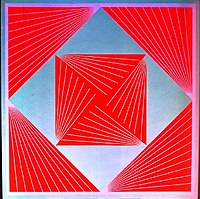
Intrinsic Harmony, by Richard Anuszkiewicz, 1965
Exhibitions [edit]
- L'Œil moteur: Art optique et cinétique 1960–1975, Musée d'fine art moderne et contemporain, Strasbourg, France, May 13–September 25, 2005.
- Op Art, Schirn Kunsthalle, Frankfurt, Frg, February 17–May 20, 2007.
- The Optical Border, The Pratt Plant of Fine art, New York, March 8–April 14, 2007.
- Optic Nervus: Perceptual Art of the 1960s, Columbus Museum of Art, Columbus, Ohio, February 16–June 17, 2007.
- CLE OP: Cleveland Op Art Pioneers, Cleveland Museum of Art, Cleveland, Ohio, April ix, 2011–Feb 26, 2012
- Bridget Riley has had several international exhibitions (e.yard. Dia Centre, New York, 2000; Tate Britain, London, 2003; Museum of Gimmicky Art, Sydney, 2004).
Run across also [edit]
- List of Op artists
- Divisionism
- Kinetic art
- Binakael (similar patterns in traditional Filipino textiles)
- Chubb illusion
- Cornsweet illusion
- Incommunicable object
- Lilac chaser
- Thousand. C. Escher
- Mach bands
- Multistable perception
- Optical illusion
- Pattern glare
- Perception
- Same colour illusion
- Trompe-l'œil
- Naught (art)
References [edit]
- ^ Artspeak, Robert Atkins, ISBN 978-1-55859-127-1
- ^ a b c "The Collection - MoMA". The Museum of Modern Fine art. Retrieved Nov v, 2017.
- ^ Jon Borgzinner. "Op Art", Time, October 23, 1964.
- ^ "Op-Fine art: History, Characteristics". www.Visual-Arts-Cork.com. Retrieved November 5, 2017.
- ^ "The Hypnotic, Listen-bending Work of Italian Designer Franco Grignani". Eye on Design. 2019-06-28. Retrieved 2019-12-15 .
- ^ "Op-Art: History, Characteristics". www.visual-arts-cork.com . Retrieved 2019-12-fifteen .
- ^ "Black Mount College Move Overview". The Art Story . Retrieved 2019-12-15 .
- ^ Bertholf. "Julian Stanczak: Decades of Calorie-free" Yale Press
- ^ "A Brief History of the Terrain Gallery". TerrainGallery.org. Archived from the original on Apr three, 2010. Retrieved November 5, 2017.
- ^ Seitz, William C. (1965). The Responsive Center (exhibition catalog) (PDF). New York: Museum of Modern Art. OCLC 644787547. Retrieved January 23, 2016.
- ^ "The Responsive Middle" (PDF) (Printing release). New York: Museum of Modern Art. February 25, 1965. Retrieved Jan 23, 2016.
- ^ Gordon Hyatt (writer and producer), Mike Wallace (presenter) (1965). The Responsive Centre (Television production). Columbia Dissemination Organization, Inc. Archived from the original on 2013-01-03. (Bachelor on YouTube in three sections.)
- ^ "MoMA 1965: The Responsive Eye". CoolHunting.com. Archived from the original on September 28, 2009. Retrieved November five, 2017.
- ^ Brian De Palma (director) (1966). The Responsive Centre (Motion picture).
- ^ Hopkins, David (September xiv, 2000). Subsequently Modern Art 1945-2000. OUP Oxford. p. 147. ISBN9780192842343 . Retrieved November 5, 2017 – via Google Books.
- ^ See Color Role Painting: The Art of Josef Albers, Julian Stanczak, and Richard Anuszkiewicz, Wake Forest University, reprinted 2002
Bibliography [edit]
- Frank Popper, Origins and Evolution of Kinetic Art, New York Graphic Lodge/Studio Vista, 1968
- Frank Popper, From Technological to Virtual Fine art, Leonardo Books, MIT Press, 2007
- Seitz, William C. (1965). The Responsive Eye (PDF). New York: Museum of Modernistic Art. Exhibition catalog.
{{cite book}}: CS1 maint: postscript (link)
External links [edit]
 | Wikimedia Commons has media related to Op fine art. |
 | Await upwardly op art in Wiktionary, the free dictionary. |
- Op Art - Tate Gallery Glossary Terms
- Opartica - Online Op Art Making Tool
Source: https://en.wikipedia.org/wiki/Op_art
0 Response to "Minimalism Op Art and Geometric Abstraction Have Which of the Following in Common?"
Enregistrer un commentaire