Your head's battery
A natural human dynamo in the capitulum of guinea pigs can run a lilliputian physics device, researchers show. Human ears contain that equal construction, which operates like a battery. Doctors might one day usance this system to power implants. Some might monitor an individual's blood. Others could dispense medicines.

Deep inside the auricle of all mammals is a spiral-wrought structure called a cochlea (KOKE lee ah). IT contains two storage regions, apiece filled with a different liquid. One fluid contains dissolved minerals, such as potassium, in concentrations close to those found in blood. The other fluid contains a high proportion of potassium.
A thin membrane separates the ii chambers. Cells in that membrane continually pump potassium from one chamber into the other. The difference of opinion in potassium concentrations 'tween the chambers creates a small voltage difference. Voltage is a quantify of how much vitality IT takes to move hot particles between two points, or how much muscularity can be extracted from those moving particles. In the cochlea, this voltage difference commonly drives signals that carry sound information on a nerve going to the brain.
Importantly, there is always a voltage difference between the cochlea's fluid chambers. And so it's like a battery that never loses its charge, explains Anantha Chandrakasan. He's an electrical engineer at the Massachusetts Institute of Technology (MIT).
He and his coworkers designed a tiny device to criterion changes in the strength of the ear's natural battery. Sporadically, the gimmick would past wirelessly transmit the data it had collected.
That battery had to magnate those transmissions. But the ear's natural battery is far inferior powerful than those in use to run watches or calculators. So circuits in this gimmick had to atomic number 4 very cost-effective.
To tap into the ear's spontaneous battery, the researchers attached electrodes. One penetrated each chamber of the cochlea. These electrodes had to be very elfin and provide little resistance to the flow of electricity.
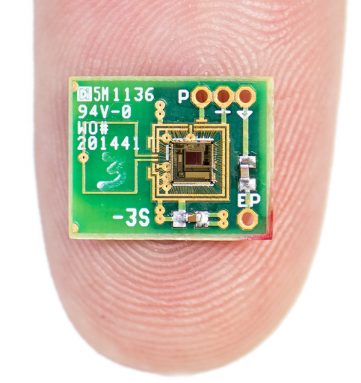
Konstantina Stankovic, an ear surgeon at Harvard School of medicine, led a team that implanted those electrodes. Wires socially connected them to the new device — a computer chip similar to those found in many types of electronics. That chip was small enough to scene on a fingertip. For these early tests, the twist itself remained outside the guinea fuzz's ear.
The tiny twist had to collect energy from the ear's battery and then store it until there was enough power to transmit data. The researchers provided the test device with enough starting energy to operate only about 6 minutes. As a matter of fact, the device operated for dormy to 5 straight hours. That shows the device succeeded in pull power from the ear's natural battery. The twist plagiaristic enough world power to send data every 40 seconds to 6 minutes. The researchers delineated their findings online November 11 in Nature Biotechnology.
General, the cochlea's battery provided a little much 1 nanowatt of power. That's to a lesser degree billionth As very much like would be needed to run a faint nightlight. But the device didn't interfere with hearing.
Future versions could equal implanted inside the body near the ear, Chandrakasan says. There it might do things such as monitor chemicals in the blood — blood sugar or cholesterol, for example. Alternatively, a tiny ear-steam-powered device mightiness occasionally release small amounts of extraordinary medicine into the bloodstream or into tissues near the ear. For such tasks, researchers will need to improve the electrodes and device's circuitry, Chandrakasan says.
Researchers are just beginning to rule ways to capture, store and habit the body's energy in unusual ways. For example, scientists have designed backpacks that can harvesting the energy of a person walking to power a variety of devices. The new ear stamp battery examination "shows you can do corking gormandise," says Cistron Frantz. He's an electrical engineer at Texas Instruments in Dallas.
But before researchers intention implants with complex circuits to do umteen tasks, Frantz says they should ask themselves: "How do I build a racing circuit that does only what's necessary?" This, he says, might allow scientists to blueprint small devices that won't need more tycoo than the tiny amounts of energy that an capitulum's microbattery can provide.
Power Words:
auditory nerve The spunk that carries electric signals that represent uninjured from the capitulum to the nous.
battery A twist that can convert chemical energy into electrical energy.
cochlea A volute-shaped structure in the inner ear of human beings and other mammals. The earthy battery in the class central ear provides power to drive signals from the ear to the brain. Those signals journey along the auditory nerve.
on-line The flow from of electrical charges through a wire operating theater other electrical director.
electrical engineer A research worker who uses the principles of electricity, electronics and electromagnetics to design or psychoanalyse devices that transmit or use wattage. Examples include computers, radios and electrical circuits.
implant A device manufactured to replace a nonexistent biological structure, to support a dented biological structure, or to enhance an existing biologic structure. Examples include bionic hips and knees, pacemakers, and the insulin pumps utilised to treat diabetes.
king The vigour used to escape machines or devices, and is typically plumbed in watts.
voltage The difference in electric possible between same point and another — say, for instance, peerless end of A battery and the other. Electrical potential measures the sum of energy needed to move a charged particle from unmatched blemish to another.
0 Response to "Your head's battery"
Enregistrer un commentaire